A testimony of the antiquity of the Khmer language are the multitude of
epigraphic inscriptions on stone. The first written proof that has allowed the history of the Khmer Kingdom to be reconstructed are those inscriptions. These writings on columns,
stelae and walls throw light on the royal lineages, religious edicts, territorial conquests and internal organization of the kingdom.
Following the stone inscriptions, some of the oldest Khmer documents are translations and commentaries of the
Pali Buddhist texts of the
Tripitaka. They were written by the monks on
palmyra palm leaves and kept in various monasteries throughout the country.
The
Reamker (
Khmer:
រាមកេរ្តិ៍, "Rama's Fame") is the Cambodian version of the
Ramayana, the famous
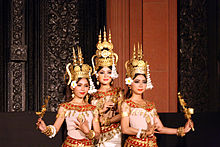
Indian epic. The Reamker is composed in rhymed verses and is staged in sections that are adapted to dance movements interpreted by Khmer artists. The Reamker is the most ubiquitous form of traditional Cambodian theatre.
Cambodia had a rich and varied traditional oral literature. There are many legends, tales and songs of very ancient origin that were not put into writing until the arrival of the Europeans. One of the most representative of these tales was the story of
Vorvong and Sorvong (Vorvong and Saurivong), a long story about two Khmer princes that was first put into writing by
Auguste Pavie. This French civil servant claimed that he had obtained the story from old Uncle Nip in Somrontong District. This story was put into writing in Battambang.
[9] In 2006 the Vorvong and Sorvong story was enacted in dance form by the
Royal Ballet of Cambodia.
[10]
Tum Teav, which has been compared
[by whom?] to
Shakespeare's
Romeo and Juliet, is probably the most well-known indigenous story, based on a poem first written by a Khmer monk named Sam. A tragic love story set during the
Lovek era, it has been told throughout
Cambodia since at least the middle of the 19th century. The story has been portrayed in many forms including oral, historical, literary, theatre, and film adaptions.
Tum Teav also has played a role in
Cambodia's education, appearing as a topic for the 12th grade
Khmer language examination several times. Although a translation into French had already been made by
Étienne Aymonier in 1880, Tum Teav was popularized abroad when writer
George Chigas translated the 1915 literary version by the venerable Buddhist monk
Preah Botumthera Som or Padumatthera Som, known also as
Som, one of the best writers in the
Khmer language.
[11]
Some talented members of Khmer royalty such as King
Ang Duong (1841–1860) and King Thommaracha II (1629–1634) have produced lasting works of literature as well. King Thomaracha wrote a highly esteemed poem for younger Cambodians. The prolific King Ang Duong is most famous for his novel
Kakey, inspired from a
Jataka tale about an unfaithful woman. While not written as a work of instruction,
Kakey is often used as an example to teach young Khmer girls about the importance of fidelity.
Shadow Theatre
Nang Sbek (shadow theatre) (or
Lakhaon Nang Sbek; Khmer) is closely related to the Nang Yai of
Thailand,
Wayang and
Indonesia like the islands of
Java and
Bali, thus implying that Nang Sbek may have an Indonesian origin many centuries ago. Nang Sbek is also a dying art form and may disappear because of the decline in popularity due to the introduction of modern entertainment. Before the spread of modern entertainment such as movies, videos and television the Khmer enjoyed and watched shadow theatre apart from the other sources of entertainment available during that time. There are three kinds of shadow theatre in Cambodia:
- Nang Sbek Thom is an art that involves mime, song, music as well as dance and narration to the accompaniment of the Pinpeat orchestra. It most often features the Reamker.
- Nang Sbek Toch also called Nang Kalun and sometimes called Ayang (small shadow theatre) uses smaller puppets and a wide range of stories.
- Sbek Paor (coloured puppet theatre) uses coloured leather puppets.
Film
Cinema in Cambodia began in the 1950s; King Norodom Sihanouk himself was an avid film enthusiast. Many films were being screened in theaters throughout the country by the 1960s, which are regarded as the "golden age". After a decline during the Khmer Rouge regime, competition from video and television has meant that the Cambodian film industry is relatively weak today.